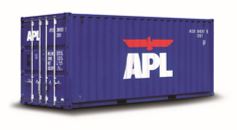
Dry container is a freight container which is fully enclosed and weatherproof, with a rigid roof, side walls and floor. At least one of its end walls is equipped with doors and it is suitable for the transport of a large variation of cargoes.
Dry containers are most commonly used. They can be used to transport most types of “dry” goods – such as those packed in boxes, cartons, cases, bags, bales, pallets, drums and so on.
Dry containers may also be used for certain types of bulk cargo by making some adjustments and using appropriate loading/unloading equipment.
Internal Dimensions
Door Opening
Weight
Capacity
Security Rings

Reefer container is a thermal container equipped with an electrical appliance (mechanical compressor) to cool or heat the air within the container.
The CMA CGM Group owns one of the youngest and largest fleets of reefer containers. With a temperature-controlled environment ranging from -35°C to +35°C, these containers are designed for the transportation of perishable commodities. Our reefer fleet comprises 20’, 40’High Cube and 45’32/33 Pallet Wide containers.
Internal Dimensions
Door Opening
Weight
Capacity
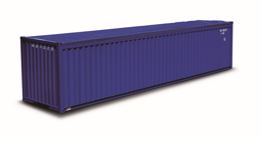
Besides not having a rigid roof, an open top container is similar in all aspects to a dry container. It has either a flexible/movable or removable cover. An open top container may have movable or removable top end above its end doors.
Used mainly to carry heavy and/or bulky products, handling and loading of these containers can only be done with a crane or a rolling bridge. For the transport of bulk minerals, half-height open top containers that can be tilted are specially designed.
Our 8’6’’ high open top containers are equipped with:
- Removable roof bows and tarpaulin
- Hinged doors (on both sides) and/or removable header above doors
Internal Dimensions
Door Opening
Top Opening
Weight
Capacity
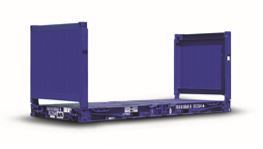
Compared to fixed-end type of flat rack containers, collapsible flat racks have end walls that can be folded. The collapsible flush folding flat rack has end walls which flush with the base when folded.
Flat racks are specially designed for the transportation of heavy, bulky cargoes as well as cargoes that are over the height and/or width dimensions of dry containers.
They also allow the stacking of several empty containers into one 'bundle' for empty repositioning. The base is often designed for the transportation of heavy material, which is why some flat racks are 45T tested. For the transportation of cargoes that are over the length dimensions of dry containers, flat racks with collapsible ends can also be used.
Internal Dimensions
Weight
Security Rings
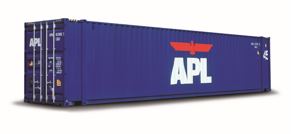
40'- 45' pallet wide units are specifically designed with the 1.2 m Euro pallet in mind. The container, with its 2.45m internal width, allows the space to be fully optimized. Shippers will benefit as they can load 5 additional 1.2m x 0.8m Euro pallets compared to a standard ISO 45’ container (or additional 1.2 x 1m pallets).
Total per tier = 33 Euro pallets in a pallet wide instead of 27 Euro pallets in a standard ISO 45’ container (or 24 x 1.2 x 1m pallets instead of 21).
High cube pallet wide containers are in compliance with the EU regulations.
The additional capacity offered by these containers can reduce distribution costs by 15% or more. Optimizing the usage of space and avoiding broken stows also help to prevent cargo movement, which may omit the need to secure the cargoes. This in turn improve dispatch times whilst reducing the costs of product packaging.
Internal Dimensions
Door Opening
Cubic Capacity
Weight
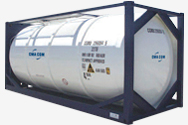
A tank container has two basic components - the tank and the framework. Used to carry hazardous or non-hazardous liquids such as foodstuff, a tank container has safety devices and is equipped with accessories to facilitate the filling and draining of liquids.
Internal Dimensions
Nominal Capacity
Weight
Max.Operating Pressure
Safety Valve Setting
Manhole
Discharge